Building a home in India from Chicago, Dubai, London, or Singapore comes with a specific set of anxieties that a locally based homeowner simply does not have to think about. You cannot drop by the site on a Sunday to see how the foundation looks. You are relying entirely on someone else's word, or their photographs, for weeks or months at a time. And underneath all of that is a quieter, more structural worry: whether the legal and financial paperwork, the power of attorney, the payment channel, the eventual resale documentation, is being handled correctly by people you are not physically present to supervise.

If you searched for NRI home construction in India, power of attorney for construction, or how NRIs build houses remotely, you are looking for a practical answer to a genuinely different problem from the one most home construction content addresses. This guide covers what your power of attorney needs to legally cover, how remote project oversight should actually work, the banking and FEMA basics relevant to funding your build, and how to keep your documentation clean enough that a future resale or fund repatriation does not become its own separate ordeal.

CHAPTER-1

Why Building From Abroad Is a Fundamentally Different Project
A locally based homeowner can resolve most construction problems with a weekend site visit and a direct conversation. As an NRI, every one of those informal check-ins is replaced by a phone call across a ten or twelve hour time difference, or a WhatsApp message you send before bed and read the reply to over breakfast the next day. This is not a minor inconvenience, it changes what actually protects you during construction. Trust in your builder is no longer something you can verify casually and continuously, it has to be built into the structure of the engagement itself: a legally sound power of attorney, a builder who provides verifiable, documented progress evidence rather than reassuring phone calls, and payment and banking arrangements that are compliant and traceable from the very first transaction.

This guide is organised around exactly those three pillars, because they are, in practice, the three places where an NRI construction project actually goes wrong when it goes wrong. Get the legal authority, the payment trail, and the oversight mechanism right at the outset, and the physical distance between you and your construction site becomes a logistical detail rather than a source of ongoing risk to your investment.

CHAPTER-2

Power of Attorney: Getting the Legal Foundation Right

What Your PoA Must Legally Cover

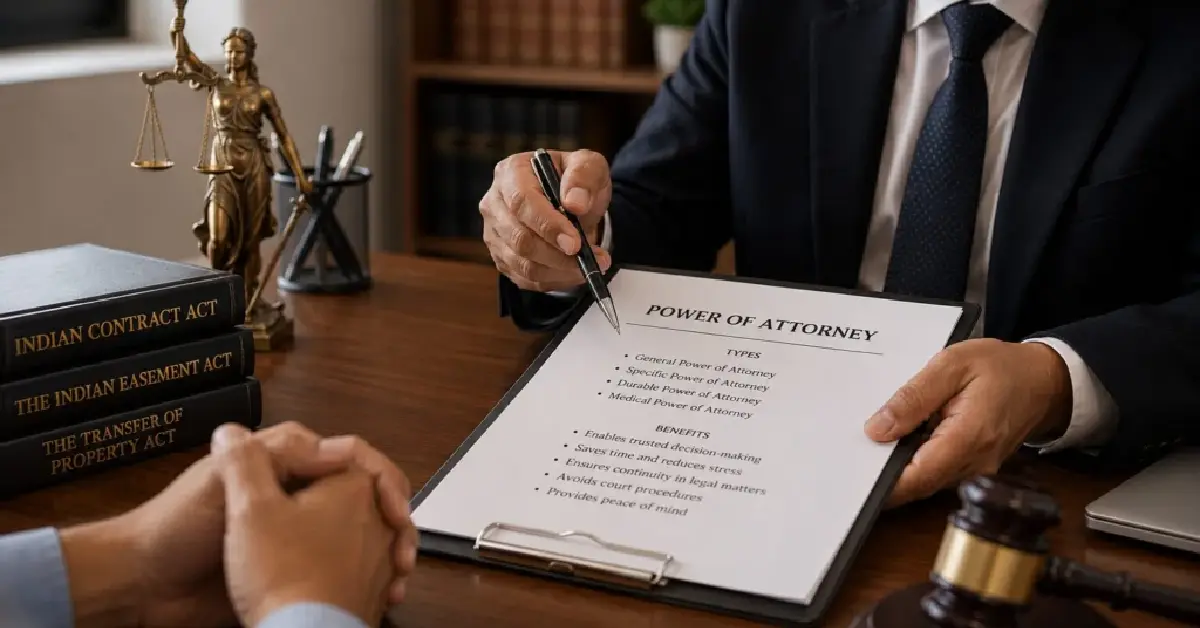
A Power of Attorney, or PoA, is the single most important legal document in an NRI construction project, since it is what allows your appointed representative, whether a family member or a trusted professional, to make decisions, sign documents, and authorise payments on your behalf while you are not physically present in India. A PoA drafted too narrowly can leave your representative unable to act on something urgent, forcing delays while you arrange a fresh document from abroad. A PoA drafted too broadly can expose you to risk if the relationship with your representative changes.

For construction specifically, your PoA should explicitly cover authority to liaise with your builder and approve design and material decisions, sign and submit documents for BBMP, GHMC, or HMDA approvals on your behalf, authorise and release milestone payments from your designated account, and, where relevant, handle post-construction steps like Occupancy Certificate and khata applications, which we cover in detail in our complete post-construction handover guide. Engaging a lawyer to draft this specifically for your construction project, rather than reusing a generic property PoA template, is worth the additional cost given how much rides on this single document being both comprehensive and precise.
Power of Attorney: Getting the Legal Foundation Right

Notarisation and Embassy Attestation

A PoA executed outside India needs to be properly authenticated before it carries legal weight for a construction project back home. In most cases, this means the document is signed in the presence of two witnesses, other than immediate family members, and either notarised locally or attested directly by the Indian Embassy or Consulate in your country of residence, both of which are generally accepted as valid. Once the PoA arrives in India, it needs to be adjudicated for applicable stamp duty by the relevant registrar's office, and this needs to happen within three months of the document's arrival in the country. Missing this window can complicate the document's legal standing later, so this is not a step to leave until it becomes urgent.

Stamp Duty and Registration

Stamp duty on a PoA varies by the state where it is being used and the specific powers it grants, and your attorney-in-fact, the person you have appointed, is typically the one responsible for completing payment and registering the document at the local Sub-Registrar's office in India. For a construction-specific PoA, particularly one that grants authority over payments and approvals, registration at the Sub-Registrar's office is the step that gives the document real legal force in your dealings with municipal authorities and your builder, rather than treating notarisation alone as sufficient. Confirm with your lawyer that this registration step has actually been completed, rather than assuming it happened automatically once the notarised document reached India.

CHAPTER-3

Remote Project Oversight: What Actually Substitutes for a Site Visit

Photo and Video Milestone Verification

The single most effective substitute for physically walking your site every week is a builder who documents every construction milestone with dated, timestamped photographs and video, tied explicitly to a specific stage of work rather than generic "progress" updates. You should be able to see your foundation, your plinth beam, each floor slab, and your finishing work as it happens, not reconstructed after the fact from a builder's verbal summary. If you are unfamiliar with what each construction stage should actually look like so you can meaningfully evaluate what you are being shown, our complete home construction timeline guide walks through every stage from foundation to handover in detail, which is worth reviewing before construction begins so you know what to expect at each update.

Live Tracking Systems

Beyond periodic photo updates, a genuinely tech-enabled builder gives you an always-available dashboard showing exactly which stage your construction has reached, what has been inspected and signed off, and which payment milestone that corresponds to, accessible at any hour regardless of the time difference between you and Bangalore, Hyderabad or Hosur. This matters enormously for NRI clients specifically, since it means you are not dependent on catching someone on a call during their working hours in India, which may fall in the middle of your night. The ability to check progress independently, on your own schedule, is one of the most practical benefits a structured, technology-driven construction company offers an NRI client compared to an informal contractor relationship that depends entirely on someone remembering to call you with an update.

CHAPTER-4

NRI Banking and Payment Considerations

NRE vs NRO Accounts for Construction Payments

Funding construction from abroad generally flows through either your NRE, Non-Resident External, or NRO, Non-Resident Ordinary, account, or through direct inward remittance from your foreign bank account. An NRE account holds foreign earnings converted to rupees and is fully repatriable, meaning both the principal and any interest can be freely transferred back abroad. An NRO account is typically used for income generated within India, such as rent from an existing property, and carries more restrictions on repatriation. For a fresh construction project funded primarily from your overseas earnings, routing payments through your NRE account, or via direct remittance, generally keeps your future repatriation options cleanest, though the right structure depends on your specific financial situation and is worth confirming with your bank or a chartered accountant before construction payments begin.

FEMA Basics Relevant to Construction

Under the Foreign Exchange Management Act, NRIs and OCIs can freely purchase residential plots and construct homes in India without needing separate RBI approval for the purchase or construction itself, provided the activity does not fall into specifically prohibited categories such as agricultural land, plantation property, or farmhouse construction. This is a meaningful reassurance for most standard residential construction projects, but it is not a substitute for professional advice on your specific situation, particularly if your funding sources are mixed, if you hold property jointly with a resident Indian family member, or if your plans include eventually renting out or commercially using part of the property. We are not a substitute for a chartered accountant here, and any NRI construction project of meaningful size should involve a CA familiar with FEMA compliance from the funding stage onward, not brought in only once a compliance question has already become urgent. This is a small, one-time cost relative to the size of a construction project, and it consistently pays for itself the moment a funding source, an inheritance, a joint account with a resident relative, or income earned in more than one country, turns out to be slightly more complex than a standard single-source remittance.

CHAPTER-5

Documentation for Future Resale or Fund Repatriation

The USD 1 Million Rule

If you eventually sell the property, RBI rules generally permit repatriation of sale proceeds up to USD 1 million per financial year from your NRO account, a limit that applies per person rather than per property or per transaction. If the property was originally purchased using funds from your NRE or FCNR account, or through direct foreign remittance, the entire sale proceeds may be repatriable, subject to a cap of two residential properties under standard rules, with proceeds from any additional property falling under the USD 1 million annual scheme instead. None of this repatriation happens automatically or without documentation, which is exactly why the next section matters as much as it does.

Keeping the Paper Trail Clean From Day One

The documentation that eventually supports a smooth repatriation, Foreign Inward Remittance Certificates, your NRE account statements showing the original source of construction funds, Form 15CA and 15CB certification, your sale deed, income tax return acknowledgements, and Form A2 declarations, is far easier to assemble correctly if the underlying transactions were clean and well-documented from the very first construction payment, rather than reconstructed years later from scattered records. Every construction payment you make should be traceable directly back to a specific NRE, NRO, or direct remittance source, with a bank statement and, where relevant, an FIRC, kept on file rather than discarded once the transaction clears. This single habit, treating every payment as a future audit trail rather than a one-time transaction, is what separates an NRI seller who repatriates their sale proceeds smoothly years from now from one who spends months reconstructing a funding history their bank can no longer easily verify.

CHAPTER-6

Choosing Between a Family Member and a Professional as Your PoA Holder
This decision deserves more thought than it usually gets. Appointing a parent or sibling in India feels natural and low-cost, and it works well in many cases, particularly where the family member has the time, temperament, and reasonable familiarity with construction to engage meaningfully with the builder. It works less well when the family member is unavailable during working hours, uncomfortable pushing back on a builder over a quality concern, or simply too far from the construction site to visit regularly themselves, which can quietly recreate the exact oversight gap you were trying to solve by appointing them in the first place.

A professional PoA holder, whether a lawyer managing the legal and documentation side or a project management service overseeing construction specifically, costs more but brings a level of construction literacy and professional distance from the builder relationship that a family member often cannot. Some NRI clients use a hybrid approach: a family member holds the PoA for convenience and trust, while a professional construction management service, or a turnkey builder's own live tracking system, handles the actual technical oversight, reducing how much construction expertise the family member personally needs to have. Whichever structure you choose, the decision should be made deliberately, with an honest assessment of who is actually positioned to catch a problem early, rather than defaulting to whichever relative is willing to say yes.

CHAPTER-7

Vastu and Design Considerations Worth Settling Before Construction Begins
Many NRI clients, particularly those planning to eventually return to India or pass the property to family, place real importance on Vastu-compliant design, and this is a decision far easier to build into your architectural drawings from the outset than to adjust once construction is underway or complete.

If Vastu compliance matters to you or your family, communicate this explicitly to your architect at the design brief stage, ideally with specific priorities identified rather than a general instruction to "make it Vastu compliant," since Vastu principles involve genuine trade-offs between different rooms and orientations that are easier to resolve on paper than on a half-built structure. Our detailed guide on Vastu factors to consider for house construction in India is a useful starting point for this conversation with your architect, particularly if you are coordinating this discussion remotely and want a shared reference point everyone involved can work from.
Vastu and Design Considerations Worth Settling Before Construction Begins

CHAPTER-8

Tax Implications During and After Construction
Beyond FEMA compliance for the construction funding itself, NRIs should be aware that property held in India carries its own tax obligations independent of your country of residence. Property tax, discussed in detail in our post-construction handover guide, applies regardless of your residency status once your home is complete and reassessed against its built-up area. If you eventually rent the property out, rental income is taxable in India and subject to TDS rules that differ from those applying to resident Indian landlords. None of this should be treated as a reason to avoid building in India, but it is a reason to involve a chartered accountant familiar with NRI taxation early in your planning, rather than treating tax compliance as a problem to solve only once a return is due or a sale is underway.

CHAPTER-9

Common Mistakes NRIs Make When Building Remotely
The same handful of mistakes recur often enough across NRI construction projects to be worth naming directly. Relying on a family member's informal, undocumented promise to "keep an eye on things" instead of a properly drafted and registered PoA is the most common, and it consistently causes the most serious problems when a decision needs formal legal authority behind it and none exists. Paying a contractor in cash or through an untraceable channel to "make things easier," rather than through a documented NRE or NRO transaction, seems convenient in the moment and becomes a serious liability at resale or repatriation, when a clean funding history is exactly what your bank and the RBI will expect to see.

Trusting verbal progress updates over documented, dated photographic evidence leaves you with no real way to verify what has actually happened on site, and no recourse if a dispute arises later about what was or was not completed by a specific date. Finally, treating the construction phase and the post-handover paperwork, OC application, khata updation, property tax reassessment, as separate problems to solve later rather than a continuous process managed by the same accountable party consistently results in NRI-owned homes that sit for years without an Occupancy Certificate, discovered only when a future sale or loan application stalls on exactly that missing document.

CHAPTER-10

Planning Around Your Actual Travel Schedule
Most NRI clients do visit India at some point during their construction project, even if not every month, and timing those visits deliberately against key construction milestones is far more useful than an ad hoc trip scheduled around unrelated family events. If possible, plan at least one visit around the foundation and structural stage, since this is the hardest phase to meaningfully inspect from photographs alone and the most expensive to remediate if something is genuinely wrong. A second visit timed closer to the finishing and handover stage lets you personally walk through the completed home, verify finish quality against what was promised, and be physically present for the final handover and any joint snag list walkthrough, rather than relying entirely on your PoA holder's assessment for the single most consequential inspection of the entire project.

Share your realistic travel calendar with your builder at the start of the project rather than after a schedule is already fixed. A builder using genuine milestone-based scheduling should be able to work with you to align key inspection points against your available visit windows wherever reasonably possible, which meaningfully increases how much of the project you can verify with your own eyes rather than through a screen.

CHAPTER-11

How BuildX.Homes Supports NRI Clients
BuildX.Homes' live tracking and milestone-verified payment system was built for exactly the situation an NRI client faces: unable to be on-site every week, but needing complete visibility and control over the build regardless of where in the world you are based. Because our turnkey model keeps design, approvals, structural engineering, and execution under one accountable company, your appointed power of attorney holder is coordinating with a single point of contact rather than juggling separate architects, contractors, and material vendors across a ten or twelve hour time difference.

If you are earlier in your planning and still identifying the right plot or construction partner from abroad, our guide on how to find a construction partner for your plot in Bangalore and our comparison of turnkey construction versus hiring a contractor are both worth reading before you commit to a builder from outside India, since the accountability gap a contractor model can create is magnified considerably when you are not able to visit the site yourself to catch problems early.
How BuildX.Homes Supports NRI Clients

CHAPTER-12

The Bottom Line for NRI Homeowners
Building a home in India from abroad is genuinely more complex than building one while living down the road from the site, but very little of that added complexity is actually about construction itself. Concrete cures the same way whether the owner is in Bangalore or Boston. What differs is the legal scaffolding, a properly drafted and registered Power of Attorney, the payment scaffolding, clean and traceable NRE or NRO transactions, and the oversight scaffolding, documented milestone evidence and live tracking that substitutes for a physical site visit. Get those three structural pieces right at the start, and the distance between you and your construction site becomes a manageable inconvenience rather than a genuine risk to your investment.

Treat these four decisions, the PoA structure, your funding channel, your oversight mechanism, and your travel timing, as the actual project plan for building remotely, and everything else in this guide becomes a matter of executing on a plan you have already thought through, rather than reacting to problems as they surface one at a time.

Frequently Asked Questions

1. Do I need to be physically present in India to start construction on my plot?

+

2. Can I pay for construction directly from my overseas bank account?

+

3. What happens if my Power of Attorney holder needs to make an urgent decision not explicitly covered in the document?

+

4. How do I verify construction progress if I cannot visit the site?

+

5. Will I be able to repatriate the full sale proceeds if I sell this property in the future?

+

6. Should I appoint a family member or a professional as my Power of Attorney holder?

+

7. Can I include Vastu requirements in my design if I am not able to be present during the design phase?

+

8. What is the biggest single risk in NRI home construction that people underestimate?

+

9. How early before construction begins should I start the Power of Attorney and banking setup?

+